.jpg)


Danish Crown Case Study
Manual Handling Instructor Programme

The Health & Safety Manager and Training Coordinator at Danish Crown’s Bugle site contracted Osteopathic Solutions Ltd in 2018 to run our Bespoke Onsite 3 Day Manual Handling Instructor (Train the Trainer) and Risk Assessor Programme (then Accredited with City & Guilds) covering job specific Manual Handling tasks across the factory floor and warehouse.
Gareth Milner (pictured instructing on the right as well as pictured below) our Director, Author of Sorry! We're Closed and Host of The Pain-Free Podcast delivered the Course for 8 attendees, who following successful completion of the Course and passing of the Practical and Written Assessment would be providing in house Workforce Manual Handling Practical Skills Training and some whom would be performing Manual Handling Risk and Ergonomic Assessments (taking the workload pressure off of the Health & Safety Manager) so that the site maintains its compliance under the Manual Handling Operations Regulations 1992, and targets-zero lost time from Manual Handling accidents.
The Bugle factory employs 450 people, processing pork legs imported from Danish Crown's factories in Denmark. Gareth Milner gave the attendees an immediate understanding of both hazardous Manual Handling practices and Optimal Manual Handling techniques by presenting our 15 minute Bespoke Manual Handling Training DVD for Pukka Pies which featured practical Manual Handling tasks in the butchery; being the same tasks as what the Bugle site employees performed. The attendees found this to be a great introduction into the Course giving them an immediate understanding of what they were going to learn and apply over the coming 3 days.
After the simply explained (i.e. zero medical jargon) and condensed classroom theory first session on laws relevant to Manual Handling operations, basic spinal anatomy and biomechanics, Gareth Milner presented a range of real life videos from different food factories featuring natural but hazardous lifting, carrying and lowering techniques and practices. These included a video at an Anglo Beef Processors factory where a worker lifted a 25kg box of beef from below knee level on a pallet, dragging it along the pallet with the right arm, then lifting with the back with minimal use of the legs. A lower back disc injury practice.


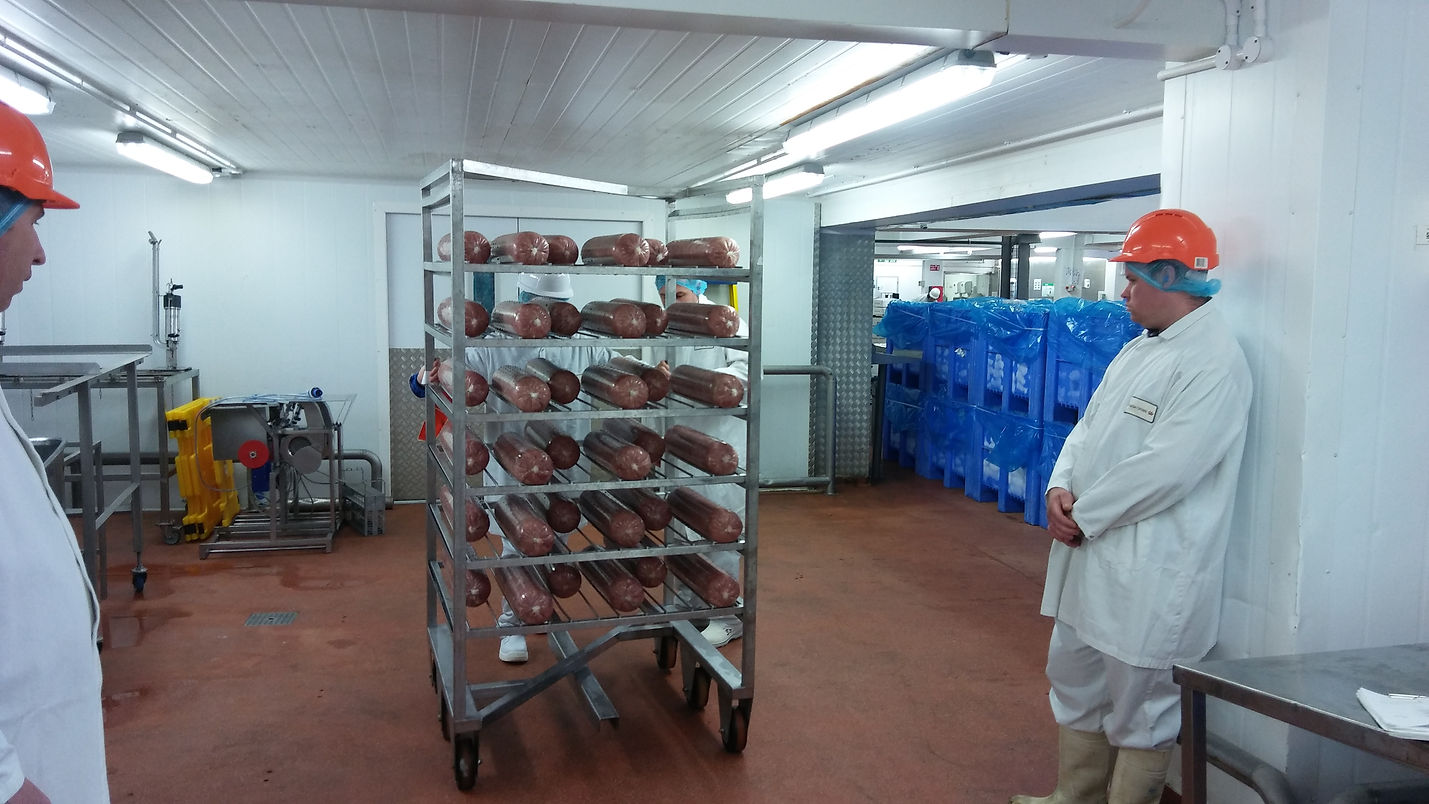
The afternoon kicked off with Gareth Milner observing tasks and loads across the factory floor environments during a walk around with the attendees. Before this Course in 2018, Gareth and the Osteopathic Solutions Ltd Team had been to abattoir and meat processing sites like this with Tulip Foods (see review above), ABP Food Group, Cranswick Foods et cetera (see 5-star reviews down this page). As Manual Handling Risk and Ergonomic Assessment had been started with the food factory task videos in the classroom, Gareth observed Manual Handling job specific tasks with the attendees whilst discussing the postural and handing issues with the Task, Individual, Load and Environment (TILE). The first Manual Handling task was transferring the poles of pork thighs (shown in the photo above) from the lorries into the factory.
There are simply tasks that we as humans cannot handle in a way that is ergonomically efficient for our musculoskeletal system. This is one. The unstable load is very heavy, with difficult coupling (grip). The environment is cold which further increases the risk of Manual Handling injuries, due to cold induced muscle stiffness. In an ideal world (with all the money in the world) this would be a fully automated task but it is commonplace with this task across the UK for operatives to manually transfer the load initially from the lorry into the factory.
As Osteopathic Solutions Ltd's Manual Handling Training is inherently practical, task specific and realistic, our Director and Author of industry leading Book Sorry! We're Closed Gareth Milner observed the attendees perform this awkward task, and then with 1-2-1 coaching tinkered with their body use and position to maximise muscle power and minimise musculoskeletal strain. The attendees were already buying into the Optimal Handling Techniques they would soon be teaching to the workforce. Optimal Handling Techniques are what our Occupational Osteopaths teach, underpinned by their Biomechanics Expertise from their Clinical Osteopathy practice, including our Director Gareth Milner BSc. (Hons) Ost. who wrote our bespoke Programme first back in 2010.


During this factory tour Gareth Milner discussed the handling issues with food totes which are a standard piece of equipment in wet based food factories including abattoirs and meat processing facilities. In the middle photo below Gareth has his arms raised forward informing the group that to support optimal posture when pushing loads, the grip on the load must be at elbow height. With food totes the grip on the load is below waist height, which enforces use of bodyweight and a forward bend of the spine, with the arms away from the body. This is high risk for neck and shoulder musculoskeletal injuries and therefore Manual Handling Lost Time Accidents. Installation of a handle up to elbow height would allow a more ergonomic pushing posture.


This heavy cage was currently positioned with 2 dolavs either side. The cage had fixed wheels and had be to spun around in the confined space to be pulled out of this position which was very physically strenuous seeing that it was being performed by a single operative. Gareth Milner flagged up this task to the Health & Safety Manager for investment to reduce musculoskeletal injury risks.
After the Manual Handling Risk Assessment group work, the Manual Handling practical started with lifting, carrying and lowering; covering hazardous practices people perform, before the Optimal Handling Techniques. After demonstrations by Gareth Milner of semi-squat and full-squat lifting and lowering, the group had their chance for practical.
As shown in the image below, Gareth Milner observes 2 attendees practising a semi-squat lift. As the attendees were soon to be training the factory floor workforce (after successful passing of the formal Course Practical and Written Assessment, Gareth encouraged the group to start their instructional practice.

Gareth Milner observed throughout the practical, correcting technique and theory when necessary. This is the way that the attendees would soon be conducting their training, providing demonstrations of the practical tasks followed up by observation of each employee performing their job specific manual handling task with constructive feedback given by the Instructor concerning the individual's task, load and environment mini-assessment, and then their individual technique regarding body position, grip and body use during the transfer of the load.
Day 2 of the Manual Handling Instructor and Risk Assessor Course started with classroom group work with the Manual Handling Assessment Charts (MAC Tool). Osteopathic Solutions' Team encourage attendees to only use the Manual Handling Risk Assessment Checklists within the Manual Handling Operations Regulations for task risk assessment however covering the MAC tool is an effective way to start Manual Handling assessments when attendees are being introduced to them for the first time. Following this, upskilling of attendees moved onto real life food factory videos of hazardous (for the musculoskeletal system) pushing and pulling practices, educating the attendees on hazardous postures and body uses, and also risk factors regarding the task, individual, load and environment. Armed with this knowledge, the group wento onto the factory floor with Gareth Milner for the morning pushing and pulling practical.


Pushing and pulling practical started with these heavy trolleys of hooked pork. Due to the trolley width with 1. widely space apart handles and 2. the operative having to outstretch their arms due to hooked pork in the way; these factors made for more musculoskeletal strain to the shoulders and neck as the upper body will be enforced to generate pushing and pulling forces.
Perhaps a safer way for the musculoskeletal system would be having a high rising pallet truck that raises the trolley up and is used to push the trolley into the oven then removed after the trolley is lowered. This would add a heavier load but would allow for a more ergonomic grip with the pallet truck handle. For Osteopathic Solutions Ltd's Manual Handling Risk & Ergonomic Assessment Consultancy options click here.
As shown in the photo above, the operative performs a hazardous push with the rear leg straight (placing considerable strain on the rear calf muscles), with only the front leg bent (placing considerable strain on the knee) and with the arms extended using body weight (placing considerable strain on the neck and shoulders). Of course this is a heavy and awkward load, but this is avoidable with adjustments to technique and body position. Following pushing and pulling demonstrations by Gareth Milner each attendee then performed the Optimal Pushing and Pulling practice possible with these trolleys. The group then moved onto pushing trolleys of cooked pork as shown in the photos below. This was a highly repetitive task for operatives and the trolleys were again very heavy. Therefore it was key for the attendees (soon to be qualified Instructors) to really understand Optimal Pushing and Pulling practice.
.jpg)
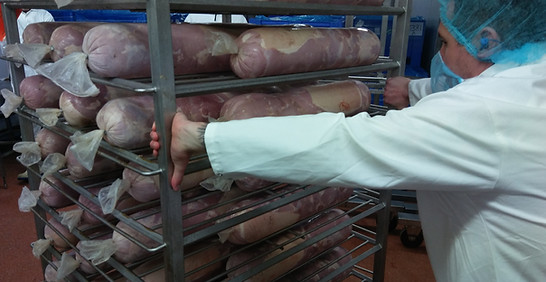
Again one of the issues with these trolleys was that there was no handle projected out from the main frame of the trolley. This enforces more use of the upper body with the arms more straight. Also there were site recommendations for grip (shown in the image to the right) with the hands inside the trolley frame. This was to prevent hand entrapment accidents happening. However this coupling causes an internal twist of the shoulder joints, and with the very heavy load weight, significant strain on the shoulder rotator cuff muscles which can easily tear and suffer from tendonitis.

Teaching factory employees Optimal practice and technique for pushing and pulling is successfully achieved by making them acutely aware of the hazardous practices they do every day. So that the shortly qualified Manual Handling Instructors could maximise their effectiveness when teaching pushing and pulling, Gareth Milner requested that each attendee pushed and pulled the trolley with natural, hazardous practices. In the photo to the right, the attendee is pulling the cage with one arm from a standing start, the most hazardous technique of pulling for the musculoskeletal system, with Rotator Cuff muscle tears and Frozen Shoulder a likely result with years of daily practice.

As all the Osteopathic Solutions Team practise, Gareth took an active part in the practical demonstrating Optimal pushing of these trolleys (shown in the photos below) which gave him a real appreciation of how physically hard factory roles are, due to the amount of times an operator would push these, and their very heavy load weight.

After a bacon sandwich lunch on Day 2, the RAPP Tool (Risk Assessment of Pushing and Pulling) was covered in the classroom using a food factory video. Each attendee paired up to work through the tool with Gareth Milner covering their answers in a group discussion.
The afternoon practical consisted of more pushing and pulling with pallet trucks, using pallets of differing load weights. As Osteopathic Solutions' Courses are task specific, Gareth Milner covered single person handling of pallets. In an ideal world pallets would be handled by 2 operatives in a team lift, carry and lower or through Manual Handling Equipment (MHE). However Osteopathic Solutions’ Team recognise that in the real world, busy factory environments' resources dictate that this is not always possible. Handling pallets on your own is hazardous for your musculoskeletal system, but Gareth coached the key principles of safest practice which each attendee practiced and performed well.


Team handling of pallets was still covered as it is simply best practice Manual Handling. Each attendee practised team lifting, carrying and lowering performing best practice communication and coordination under Gareth Milner’s expert tutelage. 3 methods of team carrying were covered.
Day 3 is about the attendees bringing together and engraining the knowledge that they have been introduced to on Days 1 and 2. The HSE’s Manual Handling Risk Assessment Checklists were covered during the morning of Day 3 with Gareth making this more engaging that it could be by linking the risk factors for lifting, carrying, pushing and pulling with risk factors that are applicable to the Danish Crown site’s tasks. In all of our Bespoke Manual Handling Courses our UK Team of true Manual Handling Experts keep it as simple as is possible; as with Manual Handling Risk and Ergonomic Assessment we recommend that the HSE’s Manual Handling Risk Assessment Checklists are solely used for assessing job specific tasks.
After the morning group practical, the Practical Assessment started. Unlike all Jacks of All Training Trades providers (listen below) who just do a multiple choice written assessment or even no assessment, we at Osteopathic Solutions take Assessment and attendee competency very seriously. Our rigorous 20-minute per attendee Practical Assessment and 45 minute Written Assessment provide your business with the assurance that the attendees have gained sufficient knowledge, understanding and practical competence to conduct the highest quality in-house Manual Handling Training and conduct Manual Handling Risk and Ergonomic Assessments both competently and effectively. The 20- minute per attendee Practical Assessment assesses Semi-Squat and Full-Squat Lifting and Lowering; Lunge Lifting and Lowering; Hazardous Carrying and Best Practice Carrying; Pushing and Pulling; Team Lifting, Carrying and Lowering.

To give the attendees a short break from the Course Assessment after lunch, using Osteopathic Solutions' extensive Course Booklet, Gareth Milner went through how to structure and deliver in house Manual Handling Training Programmes, which was kept simple so that attendees fully understood what they need to do. Throughout the 3 Day Course, Gareth gave the attendees real nuggets from his extensive national experience of Course delivery. The Course completed with the 45-minute Multiple Choice Written Assessment. A successful 3 Days at Danish Crown Bugle for all involved!
.jpg)