


Pukka Pies Case Study
Bespoke Manual Handling Training Programme
Pukka Pies' Health & Safety Manager commenced a factory wide Bespoke Manual Handling Training Programme with Osteopathic Solutions for the production workforce in 2015, so that Pukka Pies maintained their compliance under the Manual Handling Operations Regulations and more importantly for their business, targeted zero Manual Handling Lost Time Accidents.
This Programme was managed and delivered by Gareth Milner, Director of Osteopathic Solutions, Host of The Pain-Free Podcast and Author of Industry leading Book Sorry! We're Closed.
This Bespoke Training Programme was preceded by a Manual Handling Risk & Ergonomic Assessment Consultancy Osteopathic Solutions conducted in 2013 with a written report to reduce Employee Musculoskeletal Disorder risks.


Pre-programme phone conversations from Osteopathic Solutions' Director Gareth Milner with Pukka Pies' Peter Gull (then responsible for Health & Safety), ensured the employees would get the most from the job specific training and significant reductions in Manual Handling related injuries would result.
Due to a 'tight in space' factory floor it was decided that a 'Safe Training Zone' would be created away from the factory floor with a variety of factory floor loads and recreated tasks. This enabled the 100% Practical Training not to get in the way of production demands and for our Manual Handling Expert Gareth Milner to make his message stick, in a quiet, non-distracted learning environment.
Following the short briefing on (as basic as you can get) anatomy of the back and the mechanics of injury in the classroom, postural awareness was performed by each attendee involving spinal forward and backward bending, side bending and twisting. Forward bending and twisting was then performed by each attendee, so that they could feel the 'pull' on the lower back soft tissues (muscles, tendons and ligaments). These movements were related to hazardous Manual Handling techniques and practices that are naturally performed. To warm up the leg muscles for the practical, 5 semi-squats and 5 full-squats were then performed by each attendee making sure their feet were in a squat lifting position of slightly wider than shoulder width apart. Semi-squat lifting, carrying and semi-squat lowering were then demonstrated by Gareth Milner, followed by each attendee performing the task with Gareth's expert Instruction.

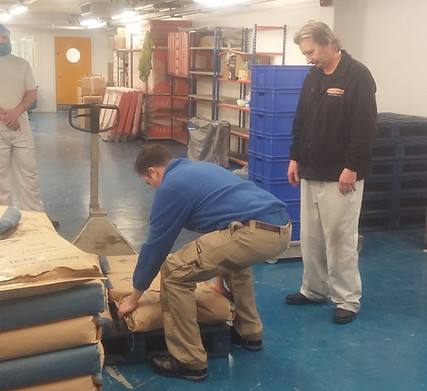
Carrying of the flour bag was performed comparing best practice and hazardous practice. Natural but hazardous practice involves carrying the load on the shoulder or under one arm. In the photo to the left, Osteopath Gareth Milner is pointing out that carrying the load on the left shoulder is causing increased contraction of the right sided back muscles making it more likely for a Manual Handling accident and resulting back spasm, a RIDDOR report and a manual handling lost time accident. As Gareth clinically treats spinal injuries as an Osteopath, he informed the group how long these painful back spasms can go on for, even with Osteopathic Manipulative Therapy and a patient tailored Exercise Therapy routine.

The job specific Manual Handling Training Programme moved on to full-squat lifting and lowering as shown in the Manual Handling Training DVD Explainer Video below. Have a watch! A ''Setting UK Standards'' product Video. A continual professional development Video.
One of the Pukka Pies attendees (shown below) was suffering from knee 'wear and tear' (i.e. osteoarthritis) and it associated chronic daily pain. Of course, full-squat technique is the technique of choice for handling loads below knee level, but with knee injuries performing this would over strain already damaged knees. Lifting with a semi-squat position is recommended by Manual Handling Expert Gareth Milner with the load close between the slightly wider than shoulder width stance.
As long as this position is performed, and the legs are used to lift the load, then the strain on the lower back will be moderate. When knees have good function, the semi-squat position to lift loads below knee level is incorrect and will place too much load weight on the lower back.
Encouraging employees to position cages when lifting trays out of and lowering trays into; in a way that allowed movement both ways over a shift was recommended. Forward bending and twisting to the same side consistently with this task will lead to spinal ligament instability as the same ligaments are overstretched, leading to chronic lower back pain.
During the factory floor walkaround before the training commenced, Gareth noted that it was common practice for employees to pull cages with the posture shown below especially with 2 cages at a time standing at the side of the cages.

As with forward bending and twisting to lift and lower loads, pulling with a spinal forward bend and twist using bodyweight is an extremely hazardous but natural Manual Handling practice. Gareth Milner encouraged the group to perform more pushing of the cages with each attendee performing Optimal Pushing Technique with Gareth providing 1-2-1 coaching as shown to the right.
Continuing with the theme of comparing hazardous practice with best practice Optimal Manual Handling Techniques, pulling of palletised loads with a pallet truck was performed by each attendee with the hazardous techniques shown below. If attendees were suffering from injuries they did not perform these natural practices.


Hazardous pulling of pallet truck with one arm

Hazardous pulling of pallet truck with backward bend

Hazardous pulling of pallet truck with forward bend
To then performing Optimal Pulling Technique with one foot in front of the other, feet hip width apart, elbows level with the trunk and then a deep semi-squat through the hips and knees, focusing the weight of the load on the front of the thigh muscles aiming to avoid a significant backward spinal bend (you will see this demonstrated on the Manual Handling Training DVD Video above). After getting the load moving (facing the load), it was recommended that the continuation of the pulling was performed with one arm but regularly alternated with the other arm on other occasions.
The awkward practice of lifting and handling CHEP pallets was then observed. In all factory environments this is commonly a single person operation. Osteopathic Solutions' Manual Handling Experts always encourage as much team lifting, carrying and lowering of pallets as is possible, as pallets are simply bulky and heavy. During single handler lifting and lowering of pallets, the load will always for a short period of time be away from the body causing spinal strain and a potential Manual Handling Lost Time Accident. The Bespoke Manual Handling Training DVD Videos we produced for Pukka Pies (for their Factory and Warehousing Operations) featured best practice Optimal Team Manual Handling of pallets.

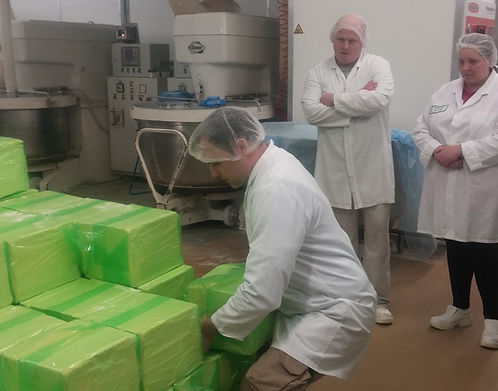
As Pukka Pies requested our 3 Hour Bespoke Manual Handling Programme was 3 hours in length (view our 2 Hour and 1 Hour Course Outlines and Learning Outcomes below), after the core practical principles were covered there was 20 minutes to relate these principles to a variety of factory floor tasks. Gareth Milner demonstrated a semi-squat lift with a 12kg cube of butter followed by each attendee. In the busy environment of food production this load was commonly lifted on one leg, with one arm, in a forward bend, side bend and twist. Osteopathic Solutions' Manual Handing Expert Trainers are realistic in the effects of training and recognise that this specific practice will not be stopped by some people, but our aims are to improve Manual Handling habits and reduce hazardous practices following training, helping Pukka Pies target-zero Manual Handling Lost Time Accidents.


Workforce
Programmes

Instructor
Qualification
Following the training delivery onsite, Gareth Milner went the extra mile and discussed some awkward tasks with Pukka Pies' Manager responsible for health and safety, including the lowering of the gravy tray as shown in the photo to the right.
As much job rotation as possible was recommended as some tasks at conveyors appeared to be low risk but involved repetitive same side spinal twisting which over time can cause spinal degeneration. Employees at the pastry making station were encouraged to perform right rotation movements before and after a shift as throughout the day they were repetitively twisted to the left.

.png)
Osteopathic Solutions' Bespoke Manual Handling Training Programme was conducted for Pukka Pies throughout 2015-2017 maintaining Pukka Pies compliance under the Manual Handling Operations Regulations 1992. For more information on our Bespoke Manual Handling Training Programmes click on the ''Made to Stick'' image below.
Our business relationship with Pukka Pies has been one of Gareth's favourites since 2010 when he founded Osteopathic Solutions Ltd. Working with Peter Gull and Stephen Ward was an absolute pleasure. Check out their great pies (especially the Chicken Balti) on www.pukkapies.co.uk

.jpg)
.jpg)